

Info
No 20% down payment for a home? 6 options many buyers don’t know about
Many people’s plans to buy a home stall on one question: where to get the 20% down payment? Six options many buyers do not know about.
For many people, the plan to buy a home gets stuck on one question – where does the down payment come from? If you have found, say, a €200,000 home, the thought of saving tens of thousands of euros can feel daunting. So the purchase is postponed, or a suitable property is given up before you even talk to the bank.
In fact, a large down payment sitting in your bank account is not the only option. What is more, the common belief that you always need 20% of your own money to buy a home is not quite true. For example, Swedbank’s website states that their standard minimum own contribution is currently 15%, with an EIS guarantee it can be 10%, for large families from 5%, and with suitable additional collateral the cash contribution can even be 0%.
As an agent I have seen all kinds of transactions, and sometimes a suitable home goes unbought simply because the buyer does not know all the options. Since I have come across these solutions in my work, I feel I also have a responsibility to share this knowledge, especially if it can help someone actually make their home purchase happen.
Here are 6 options worth exploring before giving up on buying a home.
Many still know this option as the KredEx guarantee, but today the housing loan guarantee is provided by EIS, the Estonian Business and Innovation Agency.
The EIS guarantee is intended for people who want to buy an apartment, house or residential plot, or renovate an existing home, but want to reduce the initial down payment required for a home loan. With the guarantee, the minimum own contribution is generally 10% of the value of the collateral.
For a €200,000 home, a 15% contribution means €30,000, while 10% means €20,000. The difference is €10,000.
And here is something quite a few people don’t know. The EIS guarantee is not only for families with children. The target groups include, for example, young families, young specialists, large families, veterans, tenants living in restituted housing, and buyers of qualifying energy-efficient homes.
You can read about all the target groups and their exact conditions on the EIS website.
Here comes the next option worth knowing.
While the standard EIS guarantee requires a minimum own contribution of 10%, for the large-family target group it can be just 5% of the value of the collateral. For this guarantee, EIS defines a large family as at least three children up to 19 years old together with a parent, parents or a guardian.
For a €200,000 home, a 5% contribution means €10,000. By comparison, 15% would require €30,000.
Large families should also keep an eye on the EIS home grant. Under the latest 2025–2026 measure, the maximum grant was €12,000, intended for eligible low-income large families to improve their living conditions. The home grant can be applied for during application rounds announced by EIS, and the amount and conditions may change from round to round. So always check the currently valid conditions and application round dates.
Suppose your income would allow you to make the monthly home loan payments, but you don’t have €20,000 or €30,000 in your account for the down payment.
That does not necessarily mean the purchase is off. In certain cases, additional collateral can be used instead of a cash contribution.
Suitable additional collateral could be, for example, residential property belonging to your parents or another family member. With some banks, suitable additional collateral can bring the own contribution down to 0%. In other words, if your parents have an apartment or house of sufficient value, pledging it as additional collateral can help their child buy a home without the full required contribution being available in cash.
But here comes a very important BUT.
Pledging your parents’ home as additional collateral is not just a formal signature on paper. If the borrower cannot meet their obligations in the future, the property pledged as additional collateral is also at risk. So the owner of the additional collateral must understand exactly what obligation they are taking on.
If your problem is not your ability to service the loan but the lack of a down payment, the additional collateral option is definitely worth exploring. Since banks’ terms and requirements differ, I recommend asking for offers from several banks: a “no” from one bank does not necessarily mean you will get the same answer elsewhere.
This option probably raises the most questions.
Can you really buy property in instalments? – Yes, if the buyer and seller agree to it.
Essentially, it means the buyer does not pay the full purchase price to the seller at once. The parties can agree on how much is paid immediately, the payment schedule for the remaining amount, and when and on what conditions ownership is transferred.
This can be interesting, for example, when the seller does not need the full sale amount right away, the buyer is trustworthy, but standard bank financing does not work for some reason.
The seller can benefit from such a solution too. If no buyer has been found quickly at the desired price, a more flexible payment arrangement can bring a deal to the table that would not otherwise happen.
At the same time, there are significantly more risks for both parties than in a standard bank-financed transaction. What happens if the buyer stops paying? When does ownership transfer? What happens to the amounts already paid? How is the seller’s claim secured?
All these questions must be agreed very precisely before the transaction, and property acquisition transactions must be concluded in the notarised form required by law. For such a solution, I strongly recommend consulting a notary. If you are still at the idea stage and don’t know whether such a deal could work in your situation, you can contact me first – I have come across various transaction structures and can help think through the next steps.
This is a solution that is still rarely discussed in Estonia, but in certain market conditions it can be interesting for both the buyer and the seller.
Imagine you have found a home you would really like to buy, but you don’t yet have the required own contribution, or the bank is not willing to lend the desired amount. Meanwhile, the seller may be in no hurry, and the property might otherwise sit empty for months.
One possible solution is that the prospective buyer first moves into the property as a tenant, and the parties separately agree on an option or conditions under which they can buy the property later. This gives the buyer time, for example, to save up the own contribution or improve their financial position. From the seller’s perspective it can be beneficial too. The property does not sit empty, it earns rental income in the meantime, and under the lease the tenant covers the costs of normal use. At the same time, a potential future buyer is already in place. This can be especially interesting in a tougher property market where selling takes longer and the owner would otherwise have to cover the running costs of an empty property and look after it.
But there is one very important nuance.
A standard lease does not automatically give the tenant the right to buy the property later. If the parties want to agree on a future purchase, the purchase price, a purchase option, or for example whether part of the rent payments will count towards the purchase price, the legal form must be properly thought through beforehand and checked with a notary.
It does not suit every transaction, but it is a good example of how buying a home does not always have to fit the standard “down payment + bank loan” model.
Another less-known option concerns rural areas. A slightly paradoxical situation can arise there: a person’s income would allow them to service a loan and the house may cost significantly less than in Tallinn, but the bank assesses the property more cautiously as collateral. The reason may be the location, lower demand or harder resale.
To ease this problem, EIS offers the rural housing loan guarantee.
Under the current terms, the guarantee can cover up to 80% of the outstanding principal and a maximum of €150,000. The loan limit is €200,000, and the loan can cover up to 95% of the cost of purchase and/or renovation. The value of the property being bought or renovated must cover at least 25% of the loan amount.
Among other things, this means the solution can be very interesting for someone who wants to buy a cheaper house in a rural area that needs renovation, and also needs money to fix it up.
That said, the measure does not automatically apply to every property outside Tallinn: EIS has defined the areas and conditions the property must meet. You can read the exact terms of the rural housing loan guarantee on the EIS website.
The point of this article is not to say that anyone can buy a home without their own money. The bank still assesses your income, existing obligations, ability to pay, the property being bought and the transaction as a whole. Additional collateral or an EIS guarantee does not automatically mean a positive loan decision either.
What matters is that not having a down payment does not automatically mean buying a home is impossible.
For one buyer the solution may be an EIS guarantee. For another, their parents’ property as additional collateral. For a large family, the own contribution can be just 5%. A third buyer may manage to agree an instalment plan with the seller. In some situations a “rent now, buy later” arrangement can work, and in rural areas there is a completely separate guarantee measure.
And sometimes it is enough to learn that in your case you don’t need a 20% down payment at all.
A good property deal is not always just about finding the right home. Sometimes you also need to find the right way to buy it.
If you have found a suitable home but don’t know how to structure the deal most sensibly, come for a free real estate consultation. We will review the property and the possible next steps together and, if needed, involve a bank or notary before you give up on a good home.
– – –
The information in this article is general and informative. Loan, guarantee and grant conditions may change, and every financing decision depends on the specific person, bank and property. Always check the current conditions from official sources before deciding, and seek advice from a bank, notary or relevant specialist if needed.
Many people’s plans to buy a home stall on one question: where to get the 20% down payment? Six options many buyers do not know about.

As a property owner or landlord we usually think about yield and low costs. My house in Pärnu burned down, and only then did I understand home insurance.
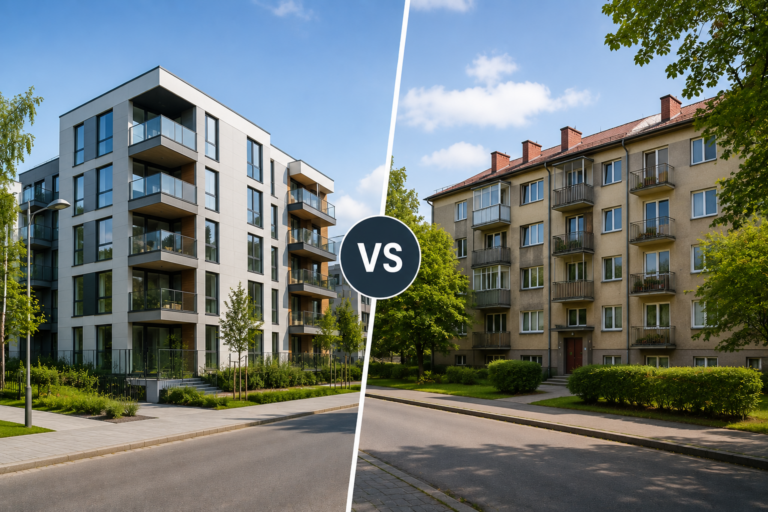
When buying an apartment, many people quickly reach one question: a new development or the secondary market? Which is the better choice today?
Once a month I send you a thorough market overview and interesting real estate finds.